Dr Gideon Blecher
Location
Melbourne, Australia. Operates out of Masada Hospital.
Costs
- Initial consultations: First consult - $360, with a $72 rebate. Second consult - $165 with a $42 rebate.
- Surgical area hair removal: Variable
- Surgery: ~$30000
- Anaesthetist fee: ~$6500
- Rebate: ~$2270 to ~$3500
- Hospital stay: ?
- Revision cost: Reportedly no cost for minor revisions (has not had anyone come back for revisions 06/2025).
Method and surgical experience
Performs Labiaplasty and Penilve Inversion Vaginoplasty. Trained by Dr Andrew Ives.
- “I would be estimating but I think when I saw him in Feb 2024 he’d done around 12, and he was doing one a month. That would put him at around 28?” - Ava
Online reports of the experience
- ?
Dr Blecher’s website
Ava’s experience
What was the process of getting to where you are now two months prior to surgery?
- The first step was to get a referral from my GP. Upon mentioning Dr Blecher, my GP mentioned that he is a good practitioner and pleasant to work with. This was in October 2023.
- After reaching out to Dr Blecher’s office I was offered a May 2024 consult, which was then brought forward to February 2024.
- The first consult involved Dr Blecher asking about my past history, why I wanted the surgery, following by a lot of information about the procedure, and the requirement that I have private health insurance that covers the MBS Item Numbers for the procedures he performs. He reviewed the risks involved, what to expect after the surgery, the pre-op requirements for WPATH and hair removal, and photos of past results.
- He then asked if I would be okay for him to do a physical examination which was a very brief exam of the tissue that he would be working with, and what kind of results I could expect with what I had.
- I then organised a follow up consult for October 2024, and his office gave me the MBS Item Numbers to start vetting PHI options. This gave me time to come back with any further questions I came up with, begin hair removal, and complete the first of two WPATH assessments. The first assessment he requires is by a Clinical Psychologist specifically, which ruled out my normal psych who is a Registered Psychologist.
- The second consult gave me the chance to ask more questions, particularly related to how my psoriasis might affect the outcome, and more questions about the aftercare. After this consult he was happy to offer me a date for August 2025, as well as the quote for the procedure (see “What were the costs involved?”).
- I could then schedule my second WPATH assessment for two months prior to that date with a psychiatrist, and complete hair removal.
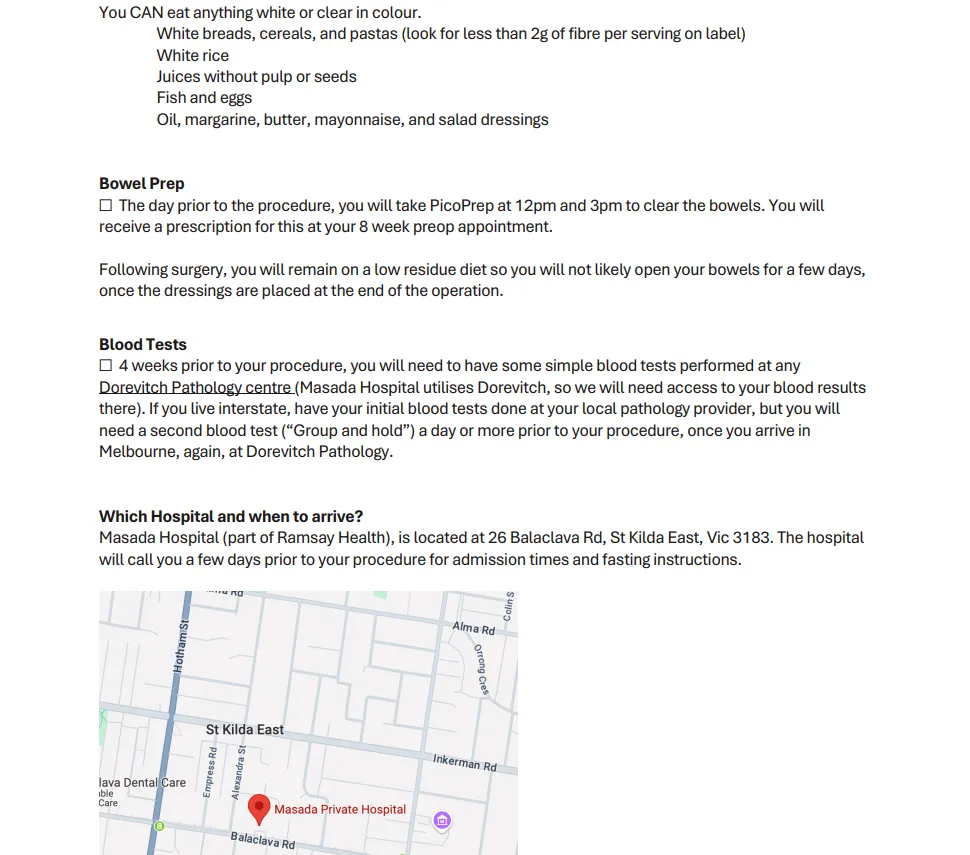
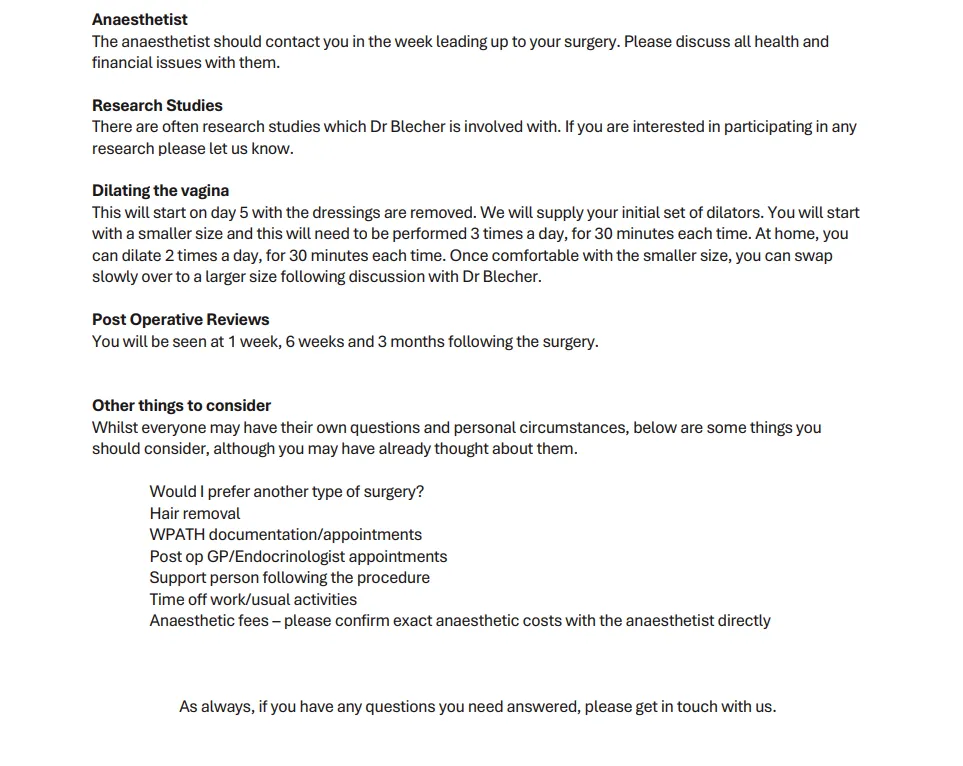
- A pre-op consult was scheduled 8 weeks before the date to review final requirements prior to surgery. These are: ceasing HRT 4 weeks before surgery, getting scripts for bowel prep, and an antibiotic cream, recommendations for a donut cushion and pads for after surgery, and dilating instructions.
Why Dr Blecher?
- Once I’d worked out my priorities for what I wanted out of the surgery, and the luxury of being able to access it in my home city, it felt like the right choice.
- He is a urologist before a plastic surgeon, so I felt assured that even if aesthetics aren’t ideal after the initial surgery, I trust that the function of such a sensitive area would have a much better chance at being maintained. I felt like there was less risk involved knowing that he is intimately familiar with the risky anatomy of the urinary tract, and operating so close to the bowel.
- I also personally feel supported by the health system here and knowing how tightly regulated it is, should there be any complications I know there are avenues to pursue remedy or compensation should the worst happen.
- He was very up front about not doing ‘porn star vaginas’, and that he is not strictly a plastic surgeon which might deter some girls, but seeing his work as well as his mentor’s work (Andrew Ives) I have no concerns about aesthetic results.
- At the time of writing, there was the bonus of a small wait time. My first consult was in February 2024, and a scheduled surgery date of August 2025. This was due to him being very new on the scene, but given his history as a respected surgical urologist, positive comments on his work ethic by medical contemporaries, and seeing photos of his early surgery results, I felt pretty confident going with him.
- I’ve spoken to a handful of people who have had gender affirmation surgeries at Masada hospital, as well as a couple of nurses who work there, and I have only heard glowing reviews of the treatment and care there. This has also been a big bonus to having Blecher as my choice.
What were the costs involved?
- As of 2025 he charges $30,000 for the surgery. There is approximately $3,500 of rebates from medicare expected after the surgery.
- The anaesthetist who will be doing my procedure is Dr Beth White, and is charging $6,500. Payment is required 2 days before surgery. I am currently unsure of medicare rebates on this fee.
- As someone with light hair (red/blonde) I have had to spend approximately $6,500 on electrolysis for hair removal prior to surgery.
- There is also the costs involved with purchasing any post-op aftercare/recovery items (TBC)
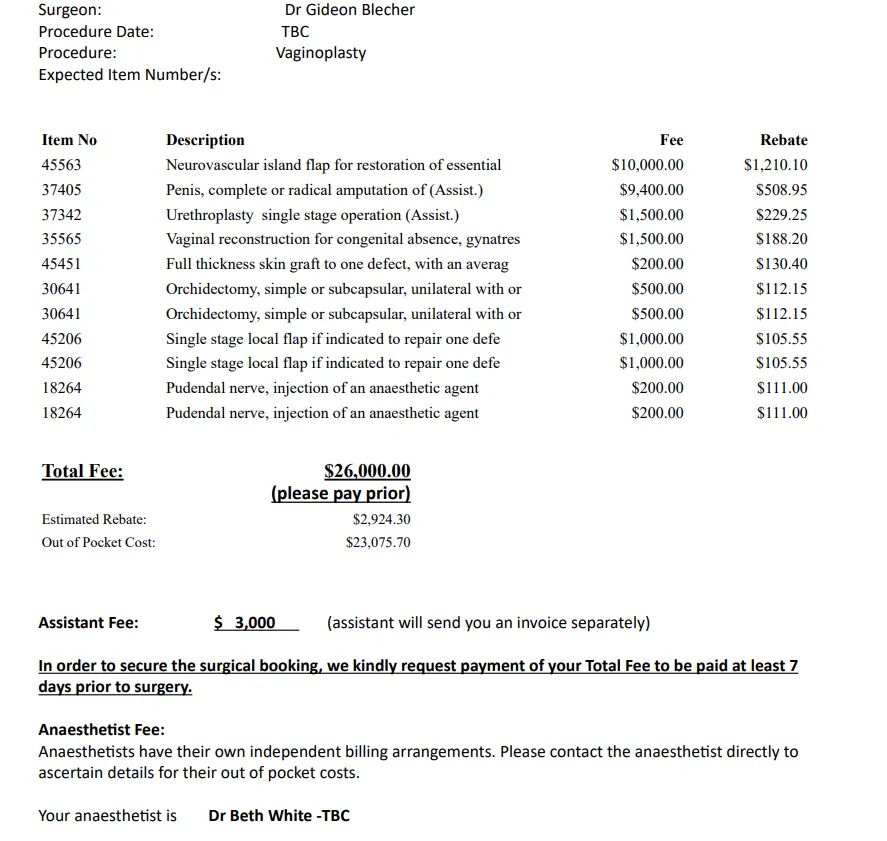
- Update 06/08/2025: Fees payable 2 days prior to surgery day were adjusted to $5,000 for unknown reason, but a welcome deduction. Rebates on this fee are approximately $900. Combined with approximate rebates from the surgeon fees, total rebate becomes approximately $4,400. Post-op the anaesthetist issues an account with a final balance due depending on the difference in cost during surgery.
- Update 06/08/2025: After purchasing everything that’s been recommended to me by the surgeon and friends, aftercare totals to approx. $500. These items include:
- Dilation:
- Puppy pads
- 5 Bath towels
- Handheld mirror
- Condoms (144 pack)
- Nitrile examination gloves
- Surgi-gel sterile lubricant sachets
- Hand sanitiser
- Fragrance free baby wipes
- Bathing:
- Douche with flexible nozzle
- Salt for saline soaks
- Sitz bath for saline soaks
- QV Soap free body wash
- Quality of life:
- Laptop/meal stand thing (to use laptop and have meals in bed)
- USB-C charger with 2 x 2m cables
- Panty liners
- Underwear
- Donut cushion
- 5 Bath towels
- Puppy pads
Which private health insurance did you choose?
I went with HIF (they’re quite publicly LGBTQI+ inclusive and mention gender affirmation surgery on their website) and I have Silver Hospital Cover, with the Advanced Extras. They confirmed that these tiers cover my stay at Masada and all item numbers.
Are revisions are covered? Medically required or cosmetic.
He hasn’t had anyone come back to him for any further major surgeries/revisions, or even minor revisions as of my last call with him earlier this month, but he did say anything minor that requires day surgery shouldn’t incur any further fees.
Have you been given any pre-op requirements?
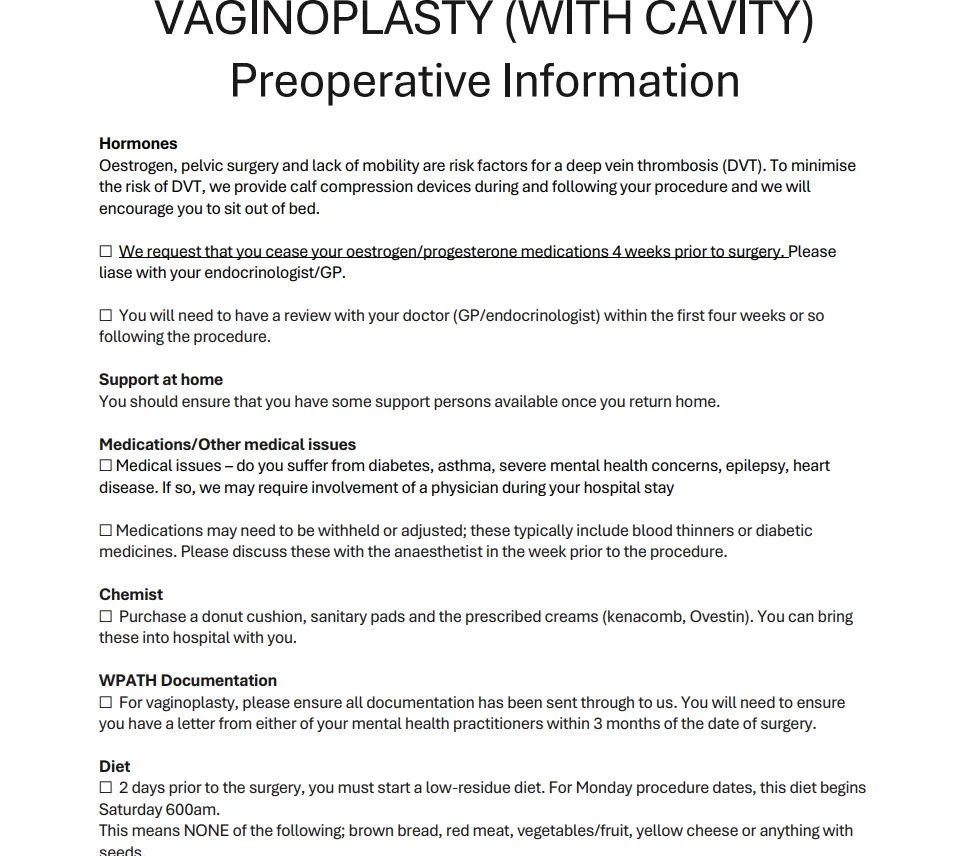
- Hair removal via electrolysis or laser is required.
- While he does perform limited follicle scraping, he will only do this for errant hairs as required when conducting the scrotal skin graft, and made it clear that it is not the preferred method of removing hair from material required to construct the vaginal canal.
- This has taken me approximately 12 months to complete. The electrolysis technician I worked with noted that I had less hair than usual, so it may take longer or less time, a very YMMV situation.
What is Dr Blecher like to interact with?
- Very friendly, if a little bit unconcerned. Definitely not cold or unfeeling, but I get the sense that this kind of operation is totally a day job for him, and he’s really chill about it. He’s clearly very confident in his abilities, he’s trained in phalloplasty, and talked about learning vaginoplasty with Andrew Ives as like an easy upskilling opportunity.
- He’s very blunt and clear about all of the risks, about what to expect from the procedure which I really appreciated.
- I would say for anyone going in to see him, don’t expect a lot of hand holding or coddling, but expect a communicative and skilled surgeon just doing his thing.
Is there anything else you think is worth communicating to others about the process so far?
- Ever since my first consult I have peppered Dr Blecher’s rooms with questions via email, and the staff have been super responsive the entire time, either giving me the information I need, or deferring to Dr Blecher himself then getting back to me. This was really helpful for me as I could clarify WPATH requirements, medical questions and such throughout the year as I progressed.
- It’s been an administratively complex process at times to make sure I got the right private health insurance coverage, have enough time for the cooling off period so I can make a claim by the time the surgery date rolls around, organising regular electrolysis sessions around work time amongst other medical necessities, and generally saving money diligently the entire time.
- This whole process has been exhaustingly expensive and has taken up most of my life in the 18 months leading up to my date. I have had to organise a bank loan to cover the bulk of the costs, while also trying to save as much as I possibly can.
- Considering the long recovery period, I’m fairly sure I’m only halfway through this marathon, and I very much leaned on my support network throughout. Have good people around you through this process.
- I hope one day this will all be covered on Medicare, and that the hardest part about accessing it is getting hair removed.
Ava’s recovery experience
General information
- The stay at Masada was really good. I’ll provide day by day details of the hospital stay, and then the following couple of months, but the most action happens in the first couple of weeks and after that it’s lots of resting and dilating.
- Along with Dr Blecher as the primary surgeon, Dr Adee-Davidson, and Dr Andrew Ives were present for my procedure. I didn’t see Dr Adee or Dr Ives before surgery, but Dr Adee would check on me a few times in the following week. The surgery took about 4.5 hours in total.
Weekend before surgery
- Saturday and Sunday are bowel prep days. Two days prior to surgery you must eat a ‘low residue diet’, which is basically anything white or clear in colour. For me this was easy because I could have eggs fried in butter on white rice with mayo one of my favourite comfort meals.
- The day before surgery - in this case Sunday - you continue with this diet up until 12pm when you must stop eating solid foods and only consume clear fluids. At 12pm you take the first of two doses of bowel prep (PicoPrep) which is easy enough as it has a pretty okay orange flavour to it. You mix powder with water and drink it briskly. You take the second dose at 3pm.
- From 12pm I was visiting the bathroom 3-6 times an hour as the bowel prep did it’s thing and you completely void your bowels. I took extra precautions for the Sunday and stocked up on clear apple juice and beef stock to sip on continuously to prevent dehydration or electrolyte loss. By the end of the day I think I’d had about 8 litres of fluid, so apart from the regular bathroom visits I felt fine.
- My parents and girlfriend stayed with me over this weekend, and were there to drive me to the hospital the next day.
Day 0 - Monday (day of surgery)
- The big day finally arrived. I was up at 5am to shower, triple check I had everything packed for the 7 day hospital stay, and get ready to head out.
- I arrived at Masada at 6:45am where I filled out a few forms for admission, then waited about 15 minutes for a nurse to come fetch me and take me to my room. My height and weight were recorded and I was given a gown to change into. They also gave me the dinner menu to fill out so they could feed me that evening, and the nurse left me in my room.
- My family and girlfriend came to wait with me for about 45 minutes. In that time another nurse came to check vitals, Dr Blecher popped in to say hello and check on me, along with Dr White the anesthetist. I asked when I’d be going into the theatre and she said ‘about 10 minutes’, everything was moving pretty promptly!
- About 15 minutes later a lovely theatre tech came to fetch me, I hugged my parents and girlfriend goodbye and I was led to a pre-op annex area. I was given a warmed blanket (to help with blood flow), a cannula was inserted in my left hand, and some final checks were done.
- Couple of minutes later I was led into the operating theatre where everything was being prepped. They were playing Dua Lipa, and Dr White asked if I wanted to put anything else on, but the vibes were good as is. I was laid down on my back, given oxygen for a few minutes before they pushed the propofol (Dr White called it penguin milk which made me giggle). All I remember from there is feeling a sudden wave of dizziness as I stared up at the surgical lights and then I was out! I dont even remember closing my eyes.
- I started waking up in the recovery room extremely groggy for obvious reasons. I could open my eyes for a few moments at a time as I slowly regained consciousness. I looked around and saw a clock and I saw that it was about 2pm. Im not sure how long I was vaguely conscious in recovery for but it felt like about 10 minutes. Dr White and a couple of nurses were there when I woke up and checked on me and my first question was whether everything went ok to which they confirmed it went well.
- Once they seemed satisfied with my condition I was offered a lemonade icy pole which I was ecstatic about getting and I was wheeled back to my room where my parents and girlfriend were waiting for me. There were a few nurses setting my bed up in the room where my blood pressure apparently dropped suddenly, but they were quick to elevate my legs and stabilise it.
- The next few hours were pretty hazy. Experienced some nausea and some pain (5ish on a scale of 1-10) but I raised this with a nurse and got meds for both pretty quickly. Nurses were checking on me once an hour. I was only allowed to sit up at high as 30 degrees in the bed for now.
- At some point during the afternoon I took note of the pressure dressings. They were these big white, kinda spongey bandages wrapped tightly around my waist and surgical site. A catheter was inserted during the surgery, and was hung on the side of my bed to collect urine. I also had some leg cuffs around my calves that would inflate and deflate every few seconds to encourage blood flow. These would stay on for most of my stay.
- Dinner was brought in at about 5pm and a nurse warned me to eat only a tiny amount to begin with so I dont vomit. I had about a spoonful of soup every 15 minutes (thanks for feeding me mum) and eventually got through about half of the meal with no nausea.
- My family and girlfriend left at around 9pm, and the night nurse came in to change dressing on the bed. They continued to check on me once an hour throughout the night checking blood pressure, blood oxygen saturation, and pain levels.
Day 1 - Tuesday
- Dr Adee came to check on me this morning briefly to see how I was doing. I managed to eat all of my breakfast with no problem. A nurse took a blood test after breakfast, then more nurses came in to give me a towel bath, check my dressings, and to change the bed pad.
- My mum came to spend the day with me, and nurses continued to check my vitals once an hour. I also learned that along with breakfast, lunch, and dinner there is also a morning and an afternoon tea service which is tea or coffee, and biscuits or a small cake. This was only the beginning of the excellent catering service there.
- A new nurse came in for the night shift, incredibly friendly and bubbly. All of the nurses were really, really nice. This nurse explained to me that I was taking Palexia - a slow release opioid - every 12 hours as well as oral antibiotics, and IV antibiotics twice per day. Blecher called the ward and a nurse gave me the phone to chat with him so he could check in. He was pretty pleased with how the procedure went.
- Pain was minimal even now, never above a 2 or 3 really. The pressure dressings and pressure from my bladder was the only real discomfort I was experiencing. However at around 7pm this day my pain was creeping up and I called a nurse in. They said I was going to be getting a Palexia at 8pm anyway, but they went away for a bit, and came back with my 8pm meds as well as an additional Endone to manage the pain.
- I also got my IV antibiotics which made me feel really nauseous and dizzy. I asked if they can give me anything for the nausea, which they could. I got one Ondansetron and was told to ask for a second if needed. After about 10 minutes I asked for the second one and it began to help. I got to sleep later that evening until about 2am, was stuck awake for a little while maybe about an hour? Got to sleep again until 5:30am.
Day 2 - Wednesday
- I woke up on the Wednesday morning feeling a lot of pressure from my bladder and the pressure dressings. I’d noted how the nurses would kinda manipulate the catheter tube to help the fluid move through, and I did the same and felt immediate relief. I was trying to drink as much water as I could my whole stay, so being able to get the catheter moving properly was really helpful to void my bladder consistently so I could keep drinking water.
- The morning nurse came to check on me at 6am to check my vitals again. Checked bed pad, normal amount of bleeding/discharge. I was looking a bit pale apparently, but the Nurse encouraged me to just keep sipping water. I was definitely feeling pretty tired and weak. I think this was the day I was allowed to sit up a bit further, 45 degrees.
- Breakfast came by at around 7am, and nurse came in again to tell me my goal for the day was to stand up 3 times. I had to void my bowels, but sill being restricted to my bed I had to use a bed pan. Honestly not as awkward an experience as i thought it’d be. The nurses being really nice helped, and I felt really safe and supported by them.
- Nurses came in to get me to stand at 11:30am and took the opportunity to change my bed sheets. They got me to roll onto my side, then sort of swing my legs down and then stand on my feet. A lovely nurse held my hand to keep me steady. No major pain, but standing up I could feel a lot of pressure in and around the surgical site.
- This was the fist time I noticed the lack of ‘stuff’ down there. The pressure dressings made it hard to see or feel much else, but this was a nice moment.
- Stood up again early afternoon with no issues. Still weak and a little lightheaded, but fine otherwise. The nurse handing over in the afternoon noted some fresh bleeding, but nothing of concern.
Day 3 - Thursday
- First big day as dressings were coming off, and I’d be disconnected from the catheter bag and allowed to use the bathroom by myself. I was also asked to try and have my meals sitting up in a chair out of bed.
- Dr Blecher was present to help remove the dressings. Getting them off was a big relief. They had been digging into my sides around my waist which left big blisters. Two small drains were also cut out, and Blecher took a photo to show me my new vagina.
- Blecher had to duck out, and the other nurses helped familiarise me with how to use the ‘flip flow’ catheter which was still inserted into my urethra, and how I would have to call a nurse every time I used the bathroom. I would have to let them know when I voided my bowel, and when I urinated it was into a little container that sat in the toilet bowl, which the nurses could check and take a measurement of how much urine I passed each time.
- I had more company for the day - my sister, and my girlfriend - and I tried to have lunch sitting in a chair. I got about 10 minutes in before I started feeling dizzy and nauseous. I asked for more anti-nausea meds and got back into my bed to nap.
- Woke up needing to pee, but was feeling nauseous still. I called a nurse and got a different anti-nausea pill to take. Gave it about 10 minutes before getting up and going to the bathroom with help from a nurse. Afterwards I stayed standing for a couple of minutes, then more nausea. My girlfriend helped me back into bed, had an up and go to see if a snack would help with nausea. Elevated my legs and finally started feeling less nauseous after a little bit.
- At dinnertime tried eating in the chair again, about 10 minutes again before getting back into bed.
- Later in the evening had a nurse help walk me to the bathroom, but successfully finished up by myself. By the time I got back to bed I was feeling nauseous (again) from standing. 10pm had my regular nerve pain and clotting meds (clexane injection, burned a bunch), and antibiotics.
- Still broken sleep, needing to pee regularly from hydrating a bunch, but focused on asking for help from the nurses.
Day 4 - Friday
- Relatively uneventful day. Used the bathroom by myself several times with no problems. Had the dressings changed on the blisters on my sides. Ate half of my lunch, and then all of my dinner sitting in the chair. I managed to walk around the ward for about 10 minutes without feeling too dizzy or nauseous, and the cannula came out before the end of the night.
Day 5 - Saturday
- Another big day as packing comes out, and dilating begins. Woke up feeling run down and nauseous. At 9:30am two nurses came in to remove the packing from the vaginal canal. Only some minor pain right as it was all being removed, very strange and new sensation.
- My nurse spent some time with me to walk me through dilating (bless you Sherie) followed by a salt bath. After all that I felt very nauseous and headachey. I asked for more anti-nausea medication and laid down for an hour until it passed. Not long after, round 2 of 3 of dilating for the day.
- Dr Adee visited again to check up on me and he was pleased with how the swelling was going. Family, girlfriend, and other friends visited in the afternoon. I managed to walk to reception and back with no nausea. Had all of my dinner in the chair! Evening dilation, meds, then bed.
Day 6 - Sunday
- Very uneventful day. Parents visited, and I dilated three times.
Day 7 - Monday, discharge day
- An early start with my catheter coming out at 5.45am. I was warned it could be a little painful, but it only stung a little for a minute. Breakfast came around not long after, and then I was asked to urinate 3 times before they would clear me for discharge. Managed to achieve this with no issues by 10am. The hospital pharmacist came in to give me my discharge meds, and a nurse walked me through the discharge notes.
- My dad and my sister picked me up a little later, packed up my things and hopped into the car with my donut pillow. The car ride was fine, getting home and realised that they forgot to include the endone in my discharge meds. Obviously I was kind of tired already, but my sister called the hospital, then Dr Blecher who organised a new script that we could pickup from the chemist. By that afternoon we went to the chemist to pick it up. I felt mostly okay but waiting for my meds for a few minutes I already felt a bit woozy. On the way home we got maccas (I wanted some comfort food so bad) which I ate at home, then napped. That 20 minute trip in the car for those 2 stops absolutely devastated me and I would experience this kind of fatigue ongoing for a couple weeks after.
- I did my first dilation at home which went well, tried a sitz bath I ordered online but it was useless, so I just switched to using the full size bath at home for the twice a day salt soak.
- That’s the end of my hospital stay! I might have forgotten a couple of names but I simply must shout out the nursing team who supported me at Masada who were incredible! Hugh, Sarah, Belinda, Frankie, Anna, Irene, Alexia, Ray, Dalal, Sherie, and Patricia and anyone else who helped with my care, it was truly a great stay for something so intensive and scary!
Recovery at home → 6 months post-op
-
Recovering at home quickly became very routine and fairly uneventful, apart from one blood clot scare (spoiler: it was a false alarm). I think the main thing I’d say is non-negotiable for the first month of recovery is having somebody around 24/7 in case of emergency, but also just to do a lot of simple things that would be impossible - or at least dangerous - to do this early in recovery.
-
The discharge meds included paracetamol a strong version of ibuprofen, two kinds of oral antibiotics, and a medication to help with urinary flow due to swelling. I found I was quite nauseous after taking all of those meds (once morning, once evening) and I called about getting a zofran prescription like I took in hospital to help with nausea. Blecher simply advised that theyre not strictly necessary and told me to just stop taking them entirely.
-
For the next couple of days the only real issue was a mild aching pain around the surgical site and muscle stiffness from lack of movement, but I would get up and walk the length of the house a few times a day. I also submitted health insurance and medicare claims.
-
I had to travel a couple hours round trip to have a checkup with Blecher at his offices in Moorabbin, which was uneventful. He took a look at the site, was happy with everything, took some notes and sent me on my way. For this and all following post-op checkups there is no charge. Got maccas on the way home again (comfort food was so important for me lol) and went straight to bed after, as the 3 hours out of the house destroyed my energy levels.
-
About a week post-op I had scheduled a checkup with my GP before surgery as a general checkup in case anything else needed addressing. I brought my extreme fatigue and shortness in as a concern, as I’ve had a history of low B12/Iron, and they scheduled some tests for me to check those things, as well as a D-Dimer. That particular test is to check for signs of blood clots. My GP explained that the reading for that test is likely to come back elevated due to a recent surgery, however: should it come back elevated the doctor will insist that I go to emergency and get scanned immediately for a clot. I went and got bloods done at 10am the following day, and at 3pm I got a call from one of the clinic doctors advising that the result was elevated and that I must go to emergency immediately.
-
This is why I advise having that support person 24/7 for the first month at least. At this point I’m still very frail, unable to drive, but I had someone with me to take me straight away. It was a bit scary, but I trusted my GP that it could simply be a false alarm. I called the hospital ward with the number they gave me upon discharge to ask if I should tell them anything specific from my stay at Masada, and then called Dr Blecher’s office which didnt go through, but about an hour later he called me back and after I explained everything he seemed very nonplussed about the situation. He doubted there was any clot but explained that this is normal procedure for an elevated D-Dimer result.
-
By 7.45pm I was in a CT scanner for the chest scan, waited another couple hours for results to come through, then got discharged with no issues.
-
A few days later I get another call from my GP to confirm that Iron levels are very low, and are likely to be causing the fatigue and shortness of breath. Options were an oral supplement which takes 2-3 months to kick in, or spend a couple hundred dollars on an infusion which only takes a couple of weeks. Considering I had to be back at work in about 40 days I opted for the infusion.
-
Within a couple of weeks I felt way better. My mood also improved a good amount. By this point I was dilating regularly and between the dilating, salt bath, shower, and clean up several hours of my day each day was just that.
-
I continued slowly sizing up the dilator until about 4 months post-op, maintaining the 30 mins twice per day schedule until 5 months where I went down to once per day with no issues. I bought further bigger dilator sizes from Bien and ended up getting to the biggest size.
-
From there on it was a lot of dilating, a lot of watching TV at home, napping, and slowly increasing the length of time I was out of the house day by day. The second month off of work I felt I could go out for a coffee with a friend for half a day before heading home, and energy just continued to improve from there.
-
I never had to touch the endone, and barely used normal painkillers throughout my recovery. I’m putting that down to my focus on my fitness pre-op, and blind luck that my body tolerated the procedure well.
-
I returned to work at the warehouse pretty much exactly 2 months post-op and started on light duties for a couple of weeks, then slowly introduced some more tasks over the third and fourth weeks. I left strenuous physical activity for a few months but began to re-introduce a gym routine in after that.
-
At 6 months post-op at time of writing I am effectively at full functioning again. Dilating still has to happen once per day with a final check up with Dr Blecher next week, but otherwise the worst of the recovery is behind me and I am thrilled with how everything went. I’ve been able to enjoy life so much more already without that persistent bottom dysphoria and I’m looking forward to doing all the things I was afraid or uncomfortable doing before :)